Concrete Driveways in Lafayette
A concrete driveway in Lafayette takes daily traffic, hard summer heat, and over fifty inches of rain a year. We start at the base. After we strip and grade the area, we compact the subgrade and set a slope that moves water off the surface instead of letting it pond against your foundation. Most residential drives get poured at four inches over a compacted base with rebar or fiber mesh, depending on the load and the soil. A spot where you park a truck or trailer gets thickened edges and a higher PSI mix. We tool control joints at the right spacing so the slab cracks where we want it to, not across the middle. Then we finish it, broom for grip or smooth where you want it, and cure it properly so it gains full strength.
Get a Free Estimate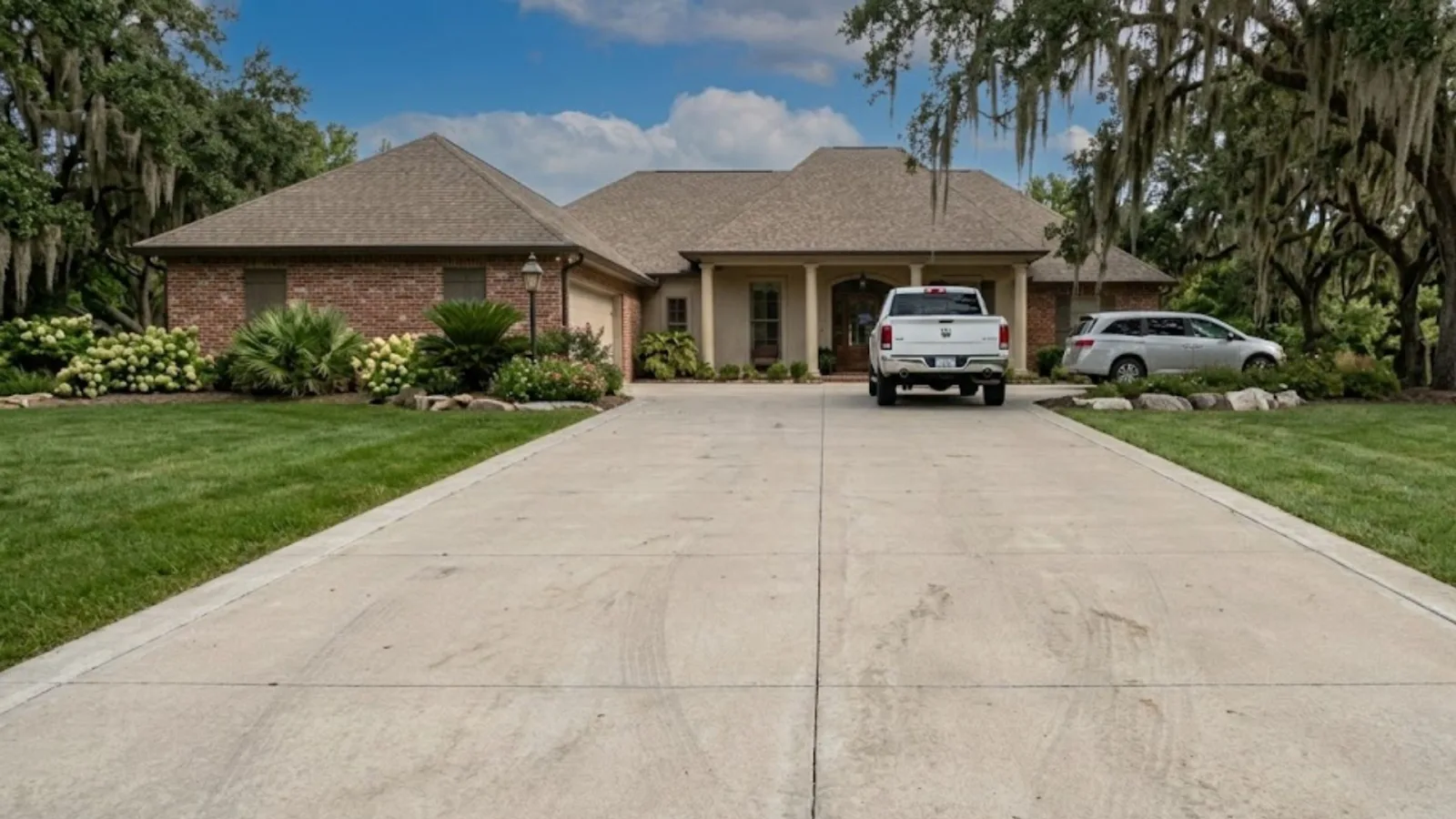
What goes into a driveway that holds up
A driveway that lasts is built from the dirt up. We strip the area, compact the subgrade, and set a slope so water sheds off the surface and away from the house. Standard residential drives go four inches thick over a compacted base, reinforced with rebar or fiber mesh depending on the soil and the load. Anywhere a truck, trailer, or RV parks, we thicken the slab and the edges and bump up the mix strength. We tool control joints at the right spacing, usually around ten feet, so the concrete cracks at the joints instead of across the open slab. Then we cure it, because concrete that dries too fast loses strength and crazes on the surface.
When to replace instead of patch a driveway
Hairline cracks and a little surface wear can be repaired. But once a drive has wide cracks with the sides at different heights, sections that have sunk or heaved, or a base that has washed out underneath, patching is throwing money at it. When the base has failed, the only fix that lasts is a tear-out and a fresh pour done right. We will tell you honestly which one your driveway needs after we look at it.
Built Right, Start to Finish
- Compacted, graded base
- Reinforced four to six inch pour
- Proper joint layout
- Broom or smooth finish
- Clean edges and apron
- Drainage that protects the slab